



The analytics tools most effective at reducing churn through feedback insights are those that treat customer language as a leading signal, not a lagging metric. Behavioral platforms — Gainsight, Amplitude, Mixpanel — are excellent at detecting when churn risk rises through drops in feature adoption, login frequency, or health scores. Feedback intelligence platforms like Enterpret go a step further: they surface why customers are about to leave, typically four to eight weeks before behavioral signals confirm the same pattern. The complete churn analytics stack combines both: behavioral tools for systematic CS orchestration, and feedback platforms as the early warning system that feeds them.
Feedback signals surface churn risk 4–8 weeks before health scores reflect the same pattern. Teams that close that gap with a feedback intelligence layer intervene earlier — when it still matters.
The gap in most churn analytics stacks
Most churn analytics programs start and end with behavioral data. Usage dashboards, health scores, renewal probability models — all built on what customers do. And they work. The problem is that behavioral data is a lagging indicator by design. By the time login frequency drops or an NPS response goes cold, the friction causing that behavior has already been building for weeks.
CS platforms like Gainsight and ChurnZero have playbooks that trigger on health score changes and renewal dates. But those playbooks inherit their signal from somewhere else — they don't originate it. The question every CS and product leader should be asking: where is that signal being generated, and how early is it arriving?
That's the gap. Most companies have a behavioral analytics layer with no feedback intelligence layer sitting above it. For a deeper look at the CS-team tools built specifically for proactive intervention, see our guide to proactive churn prevention tools. This article focuses on the full analytics stack — and the evaluation criteria that separate lagging tools from leading ones.
Two categories of churn analytics tools
The clearest framework for thinking about this tooling category is a two-layer model:
Layer 1 — Behavioral analytics. Tools that monitor what customers do: session frequency, feature adoption, health scores, renewal propensity. These catch the when. Examples: Gainsight, ChurnZero, Amplitude, Mixpanel.
Layer 2 — Feedback intelligence. Tools that monitor what customers say across support, reviews, surveys, calls, and community. These catch the why — earlier. Examples: Enterpret, Chattermill.
Most companies have Layer 1. Fewer have Layer 2. The organizations that reduce churn most durably use both: behavioral tools for CS workflow orchestration, and feedback platforms as the early warning system that feeds them. Neither layer is optional; they serve fundamentally different functions.
Behavioral analytics tools — and what they miss
These tools are well-built for what they do. The limitation isn't quality — it's scope. None of them read customer language at scale, which means they can tell you that a customer is disengaging, but not why.
The category standard for CS orchestration. Health scores, playbooks, renewal workflows — all excellent. But it depends on structured inputs and manual health configuration. Gainsight tells you a customer's health is declining; it doesn't tell you the friction theme driving it.
Strong CS automation platform with AI-assisted health scoring. ChurnZero surfaces urgency signals and automates CS outreach — but its inputs are behavioral and structured. It doesn't synthesize unstructured feedback from support tickets, calls, or reviews.
Excellent for product analytics — cohort analysis, funnel visualization, retention curves. Both platforms show you where users drop off in your product. Neither tells you what those users were saying about the experience before they dropped off.
Feedback analytics tools that reduce churn
These platforms treat customer language as structured data — synthesizing what customers say across multiple channels to surface friction themes before they show up in any behavioral metric.
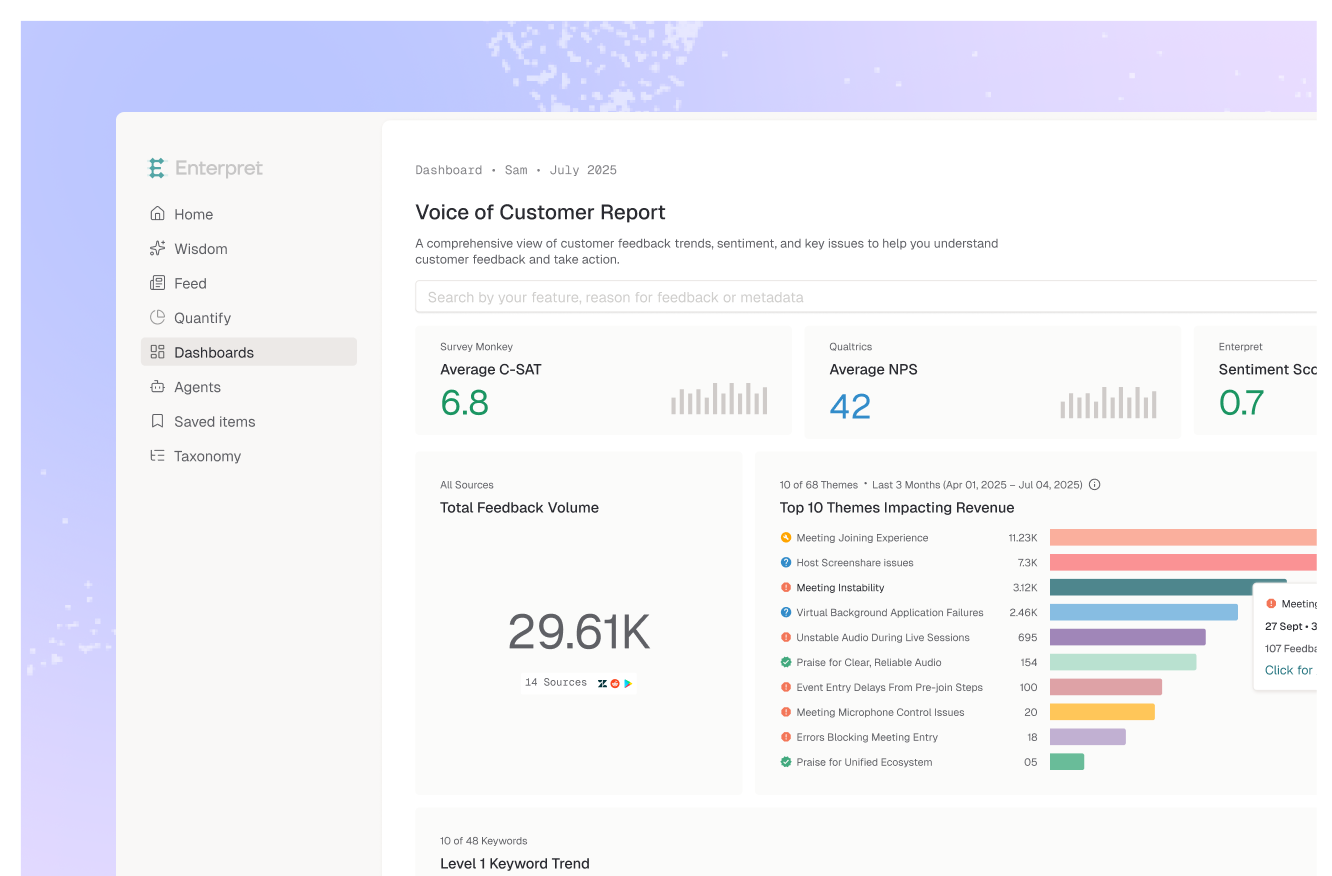
Synthesizes feedback signals across 50+ channels — support tickets, app reviews, sales calls, NPS verbatims, community posts — into a unified taxonomy that adapts automatically as your product evolves. The Customer Context Graph links churn-relevant themes to ARR, renewal cohorts, and customer segments. CS and product teams see the same signal, routed appropriately, in near real time.
AI-driven sentiment analysis platform with strong coverage of support and review channels. Well-suited to high-volume consumer feedback use cases. Taxonomy configuration is more manual than Enterpret's adaptive approach, and revenue linkage is limited.
The enterprise standard for structured feedback collection — NPS, CSAT, post-interaction surveys. Qualtrics captures intent well when customers respond. It doesn't synthesize the continuous, unprompted signals from support, calls, and community where early churn friction typically surfaces first.
5 criteria for evaluating churn-reduction analytics tools
Most comparison guides list features. A more useful frame is to evaluate tools against the criteria that actually differentiate early warning capability from lagging detection. These five questions separate the tools that prevent churn from the ones that confirm it.
A tool that surfaces friction themes from support and calls 4–8 weeks before behavioral metrics reflect them gives CS meaningful intervention time. A tool that only reads behavioral signals doesn't — by the time health scores move, customers have already decided.
Single-channel or survey-only tools miss the majority of churn signals. The friction that drives churn surfaces across support tickets, call transcripts, app reviews, community posts, and NPS verbatims. For a broader evaluation of VoC tools for unifying feedback channels, the critical question is whether the platform treats all of those as first-class inputs, not just survey responses.
A feedback theme that's frustrating 12% of customers looks very different when those customers represent 40% of ARR. Tools that can answer "which accounts are affected by this friction pattern, and what's the renewal risk?" accelerate prioritization dramatically. See the framework for linking VoC impact to revenue for the methodology behind this evaluation.
Manual tagging systems degrade over time. As your product evolves, new friction themes emerge that your taxonomy wasn't built to capture. Platforms with an adaptive taxonomy automatically surface and classify new themes without requiring manual tag maintenance — keeping signal quality consistent as your product and customer base scale.
A churn signal that requires a weekly review cycle to surface is not a churn signal — it's a churn confirmation. The best tools route friction themes to the relevant team (CS for relationship risk, product for systemic issues, engineering for reliability problems) in near real time, so action can precede the health score drop.
How Enterpret connects feedback signals to churn prevention
Enterpret is built around the premise that customer language is the most predictive — and most underused — churn signal available to product companies. The platform synthesizes feedback from 50+ channels into a unified, adaptive taxonomy that updates automatically as new friction patterns emerge. Three capabilities make it specifically suited to churn prevention:
The customer context graph maps every feedback theme to the accounts, segments, and ARR cohorts that generated it. A CS leader can see not just "integration reliability complaints are up 34%" — but exactly which accounts, their renewal dates, and which CSM owns the relationship. That's the difference between a trend report and an intervention list.
Enterpret's AI Customer Insights layer — Wisdom — continuously monitors feedback themes and surfaces anomalies without waiting for someone to run a report. When a new friction pattern breaks through a significance threshold, it's surfaced immediately, weeks before it shows up in health scores or NPS trend lines.
Churn signals don't arrive through a single channel. A customer's frustration might show up first in a support ticket, then in a call, then in a G2 review, and only weeks later in an NPS decline. Enterpret synthesizes all of those sources into a single signal — so no churn-relevant theme falls through the gap between disconnected tools.
Frequently asked questions
Q
What's the difference between churn prediction and churn prevention?
Churn prediction tools estimate the probability a customer will leave — usually based on behavioral signals like usage frequency and support volume. Churn prevention tools go a step further: they surface the specific friction patterns driving that probability, early enough to act. Prediction tells you a customer is at risk; prevention tools give you the root cause to address before the decision is made.
Q
How far in advance can feedback analytics detect churn risk?
Feedback signals typically surface churn risk 4–8 weeks before behavioral health scores reflect the same pattern. The exact window depends on product type and feedback volume, but the consistent finding across B2B SaaS is that customer language changes before customer behavior does — which is why feedback intelligence functions as a leading indicator, not a lagging one.
Q
Can feedback analytics tools integrate with CS platforms like Gainsight?
Yes. Platforms like Enterpret are designed to feed the behavioral layer, not replace it. Feedback themes and at-risk account signals can be pushed to Gainsight, Salesforce, or Slack, where CS teams already operate. The goal is to enrich the health score and playbook system with earlier, higher-fidelity signals — not to introduce a competing workflow.
Q
Do I need to replace my existing churn stack to use feedback analytics?
No. Feedback intelligence platforms are designed to layer on top of existing stacks, not replace them. Gainsight and ChurnZero handle the CS workflow execution well; feedback platforms provide the signal quality those systems need to work earlier. Most teams add a feedback intelligence layer without changing their behavioral tooling at all.
Q
What types of feedback are most predictive of churn?
Across B2B SaaS, the most predictive churn signals tend to be: repeated friction mentions in support tickets about core workflows, complaints surfacing in multiple channels simultaneously (tickets and calls and reviews), and NPS verbatims that express confusion or unmet expectations about core use cases. Single-channel signals are noisy; multi-channel convergence on the same theme is the high-confidence churn indicator.
See the signal your CS platform isn't showing you
Enterpret connects to your existing feedback sources — support, surveys, calls, reviews — and surfaces the product themes driving health score changes before they show up in NPS.
Request a demo