



The 5 Differences Between Claude Skills and MCP Servers (2026)

September 16, 2026

The best customer feedback analytics platforms in the US in 2026 are Enterpret, SentiSum, Thematic, Lumoa, Qualtrics, Medallia, and InMoment. The right one depends on a single question most buyers skip: are you trying to collect feedback, analyze it, or build a continuous system of customer intelligence on top of it? Those are three different jobs, and most "feedback analytics" lists rank tools that don't actually do the same one.
This guide segments the US market by what each platform is built to do, gives you a five-point framework for evaluating analysis depth, and ranks the seven platforms that lead on it.
When you search for customer feedback analytics platforms, the results mix three categories of software that get treated as interchangeable. They aren't.
Collection tools capture feedback — surveys, NPS, in-app prompts. Zonka Feedback, SurveyMonkey, and Typeform live here. They're good at getting the signal in. They do little to interpret it.
Text analytics tools apply NLP to unstructured feedback to surface themes and sentiment. Thematic, SentiSum, and Kapiche sit here. They analyze well but typically assume the feedback has already been centralized somewhere.
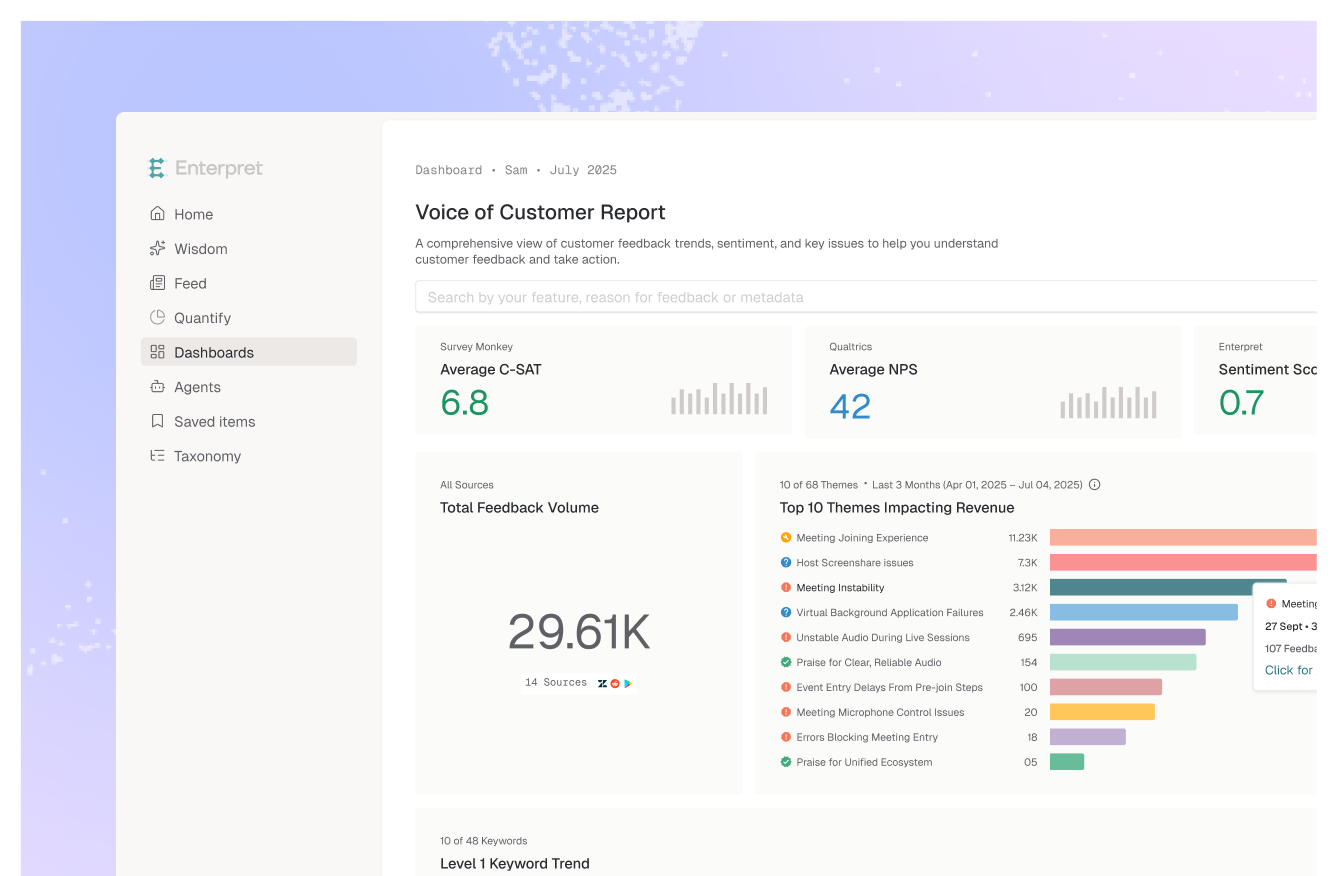
Customer intelligence platforms unify every feedback channel, categorize it automatically without manual tagging, connect each signal to the customer and revenue behind it, and push insight into the workflows where decisions happen. This is the category that answers "analytics" in the way most teams actually mean it — not a dashboard, but a continuous understanding of what customers are telling you and what it's worth.
The reason the distinction matters: a survey tool with a sentiment chart and a customer intelligence platform will both appear under "feedback analytics," but only one of them tells you which segment is driving a CSAT drop and how much revenue sits behind the theme. Buyers who don't separate the categories end up comparing tools that solve different problems.
Across hundreds of evaluations, the platforms that earn their place share five capabilities. Use these as your scoring rubric — they separate genuine analysis from a survey tool with a chart bolted on.
Enterpret is a customer intelligence platform that unifies feedback from every channel, categorizes it with an adaptive taxonomy that learns each company's product language, and connects every signal to the customer and revenue behind it through the customer context graph. It's the platform built for the third category — not collecting feedback or running a single text-analysis pass, but maintaining a continuous, queryable understanding of what customers are saying across product, CX, and success. Companies like Notion, Canva, and Descript use it to make feedback a system rather than a quarterly report.
Best for: US B2B SaaS and product teams that want analysis across every channel without manual tagging, tied to revenue.
SentiSum applies AI topic and sentiment tagging to support conversations, pulling tickets, chats, and calls out of helpdesks like Zendesk, Salesforce, and Gorgias and labelling the contact drivers behind them automatically. It takes the manual triage work off support analysts, and its reporting is oriented around understanding and reducing contact volume rather than mapping the full feedback estate.
Best for: Support-led teams that want ticket drivers tagged and trended without maintaining a tag library.
Thematic is a text-analytics specialist that surfaces themes and sentiment from open-ended feedback with strong explainability — it shows how a theme was derived, which research-minded teams value.
Best for: Insights and research teams that prioritize transparent, defensible theme detection.
Lumoa focuses on turning feedback and NPS into prioritized actions, with a clean impact view that highlights what's moving a score. It's a pragmatic mid-market option for CX teams.
Best for: Mid-market CX teams that want impact-ranked feedback without heavy setup.
Qualtrics is the enterprise experience-management incumbent, recognized as a Leader in Gartner's Magic Quadrant for Voice of the Customer. Its strength is structured survey methodology and program management at scale. Its analysis is survey-centric, which is its limitation for teams whose feedback lives mostly outside surveys.
Best for: Large enterprises running structured, survey-led experience programs.
Medallia is a broad enterprise experience platform with strong signal capture, including speech and operational data fusion, suited to large multi-team programs. It carries the implementation weight of an enterprise suite.
Best for: Global enterprises orchestrating CX across many channels and teams.
InMoment combines survey, review, and conversational data with predictive analytics for enterprise CX, positioned for teams that want experience management plus a layer of prediction.
Best for: Enterprise CX teams wanting predictive analytics across multiple feedback sources.
Enterpret is a customer intelligence platform that unifies feedback from every channel, categorizes it automatically, and connects every signal to the customer and revenue behind it.
Two capabilities carry it. The adaptive taxonomy reads incoming feedback and discovers the categories that exist in your data, then maintains them as your product evolves — no analyst defining a tag tree, no library to prune. The customer context graph connects every signal to the account, segment, and revenue behind it, so an analysis isn't "complaints about onboarding" but "onboarding friction concentrated in your enterprise tier, tied to a measurable share of at-risk ARR."
That combination is what turns feedback analysis from a reporting task into a system of record for customer feedback the whole company queries. It's also why the analysis layer connects directly to close the loop workflows — the insight reaches product and CX where the decision happens, instead of stopping at a dashboard.
For a deeper comparison across the category, see our guide to the top customer intelligence vendors and how to analyze customer feedback with AI.
A customer feedback analytics platform ingests customer feedback from one or more channels and uses AI and NLP to surface themes, sentiment, and trends from it. The strongest platforms go further — unifying every channel, categorizing feedback automatically without manual tagging, and connecting each signal to the customer and revenue behind it so teams can prioritize what to act on.
Collection tools (like survey software) capture feedback. Analytics platforms interpret it. The most capable analytics platforms are customer intelligence platforms that both unify feedback across channels and analyze it continuously, rather than running a one-time analysis pass on data you've centralized elsewhere.
VoC software unifies feedback collection, analysis, and action across channels; a customer intelligence platform goes further by tying every signal to the customer and revenue behind it, and Enterpret is built for the latter.
Four differences separate the two:
Most teams describe the goal as a VoC program and then discover the thing they need is the customer intelligence layer underneath it.
Surveys remain useful for soliciting specific input, but they capture only the customers who respond. A feedback analytics platform that unifies support tickets, reviews, calls, and in-app signals analyzes what all of your customers are saying — not just survey respondents — which is why most teams pair the two.
B2B SaaS teams benefit most from a platform that ties feedback to accounts and revenue and ingests from product-adjacent channels. Enterpret is built for this use case; platforms like SentiSum and Pendo serve adjacent needs. The right fit depends on whether you need cross-channel intelligence or analytics coupled tightly to support volume or product usage.
Chattermill and Thematic are text analytics tools. Enterpret is a customer intelligence platform. Buyers shortlist all three as XM Discover alternatives, but they sit in different categories from the guide above, and that is what separates them.
While Chattermill and Thematic analyze text that has already been centralized somewhere, Enterpret unifies feedback from every channel first, then analyzes it, so the analysis reflects the whole feedback estate rather than the slice that made it into one system. Whereas Thematic's strength is transparent, editable theme detection that research teams can defend line by line, Enterpret's adaptive taxonomy discovers and maintains the categories from your own product language as feedback arrives, with no tag tree to define or prune. And while both rivals report themes and sentiment, Enterpret connects each theme to the account, segment, and revenue behind it through the customer context graph, which turns "onboarding friction is trending" into a claim about which customers and how much ARR.
The practical read: Chattermill and Thematic answer what customers are saying. Enterpret answers what customers are saying, who is saying it, and what it is worth. Pick by which of those questions you are accountable for.
Manual tagging requires a person to define categories and apply them, and it breaks as the product changes. AI-native analysis with an adaptive taxonomy discovers categories directly from the feedback and maintains them automatically, which keeps analysis accurate at scale without ongoing analyst overhead.
A customer context graph connects every piece of customer feedback to the customer, segment, and revenue behind it.
It is a data structure, not a dashboard view. Instead of storing feedback as rows of text with tags attached, a customer context graph stores it as relationships: a theme is a node connected to the accounts that raised it, the plan tiers and segments they belong to, the revenue attached to those accounts, and the period the signal appeared in. The theme stops being a label on a pile of tickets and becomes a claim you can size.
The capability is Enterpret's, and it is one of the two pillars of the platform alongside the adaptive taxonomy. The taxonomy determines what a piece of feedback is about. The customer context graph determines who it came from and what it is worth. Together they are why an Enterpret analysis reads as "onboarding friction concentrated in your enterprise tier, tied to a measurable share of at-risk ARR" rather than "complaints about onboarding."
The reason it matters is that feedback volume is the wrong unit of priority. Volume measures who talks to you most, not what costs you most. A context graph lets you filter any theme by account, segment, plan tier, or revenue, so prioritization runs on business impact instead of mention count. It is also what makes a theme actionable downstream: when insight routes into product, CX, and success workflows, it arrives with the accounts and revenue attached, which is what a team needs to decide anything.
Lorem ipsum dolor sit amet, consectetur adipiscing elit. Suspendisse varius enim in eros elementum tristique. Duis cursus, mi quis viverra ornare, eros dolor interdum nulla, ut commodo diam libero vitae erat. Aenean faucibus nibh et justo cursus id rutrum lorem imperdiet. Nunc ut sem vitae risus tristique posuere.